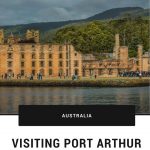
Port Arthur is a small town and UNESCO World Heritage-listed former convict settlement on the Tasman Peninsula in Tasmania. As one of Australia’s most significant heritage sites, visiting Port Arthur offers a powerful journey through time. With its hauntingly beautiful ruins and preserved buildings, the site tells a story marked by both the hardships of the convict era and the sorrow of more recent events.
Most people who go to Port Arthur travel from Hobart to the site. Port Arthur is about a 1 hour and 30 minute drive from Hobart. If you are staying in Hobart, I recommend you get up early to make sure you are at Port Arthur when the gates open at 9am.
If you are in Hobart you can take a day tour that includes Port Arthur as well as other sites along the Tasman Peninsula. The other options are to hire a car and drive yourself. There is plenty to see on the trip and a hire car allows you to stop when you want. Buses also run from Hobart to the site.
We stayed at Eaglehawk Neck (across from the Tessellated Pavement) which is 25 minutes from Port Arthur so that we could be at the site when the gates opened. This allowed us to get a car park close to the entrance. It also meant that there was only one person in the queue to get tickets before us. At about 2pm the main entrance was so busy with people arriving that we struggled to get through to the exit. There is also accommodation around Port Arthur.
Your Port Arthur entrance ticket is valid for two consecutive days. It includes:
By being at the site at 9am for opening, it gave us an opportunity to get photos without crowds of people. On the day we visited a P&O cruise ship was anchored in the bay and the passengers disembarked throughout the day making it busier than usual.
Check Port Arthur’s website for ticket prices.

Port Arthur was not originally a penal settlement, but rather it was a timber gathering camp using convicts to acquire timber logs for government projects. This first settlement was established in 1830.
Three years later in 1833, Port Arthur started to be used as a convict settlement for repeat offenders. Convicts from other Australian colonies would be sent to Port Arthur if they re-offended. Port Arthur was never used as a convict settlement for convicts when they first arrived in Australia.
Within seven years, in 1840, more than 2,000 people were at Port Arthur. This included soldiers and civilian staff and their families as well as convicts.
However, by 1853, convicts were no longer beings transported to Tasmania (Van Diemen’s Land). Port Arthur was then transformed into a facility to house aging convicts and convicts that were physically and mentally ill.
It was not until 1870 that the settlement was closed.
The historical importance of Port Arthur was recognised in 2010 when it and 10 other historical sites that form the Australian Convicts Sites were World Heritage listed.
An additional tragic chapter was written into Port Arthur history on 28 April, 1996. On that day a lone shooter took the lives of 35 people and injured at least another 18 people.
When you do the guided tour of the site, the tour guides tell visitors of the shooting and that guests and employees lost their lives. They will also recommend you visit the memorial to pay your respects. There is no mention of the shooter’s name (out of respect, I have not mentioned the shooter’s name either).
The shooting changed Australia forever and also resulted in gun control being introduced into Australia. The gun laws included the banning of fully automatic and semi automatic firearms. It also included a mandatory 28 day cooling off period before getting a gun licence and you required a ‘genuine reason’ for owning a gun (self-defence was not an appropriate reason).
A gun buy-back also resulted in about 700,000 legal and newly made illegal guns being handed in and destroyed. There has not been a mass shooting in Australia since.
This tragic chapter in Port Arthur and Australia’s history is also one of largest mass shootings in the world.
The Memorial Garden includes a cross containing the names of those who lost their lives. It also includes a memorial pool. The memorial stands on the site of the Broad Arrow Cafe. 20 people lost their lives in the cafe. The memorial pool was created as a place of remembrance and reflection and when visiting Port Arthur, spend some time at the memorial to pay your respects.


The Penitentiary is the most imposing building and one of the first you see when you enter the Port Arthur site.
When it was in use, convicts were split into two groups in the Penitentiary. The convicts who were considered to be of ‘bad character’, were housed in cells in the two lower floors of the building. Better behaved convicts had a much better view on the top level of the building and had the benefit of being able to sleep in bunk beds. The lower two floors contained 136 cells while 480 convicts slept on the top floor.

The church sits above the Government Gardens and shows the amazing stonework that was crafted by convicts, many of them boys from the Point Puer Boys’ Prison. You can visit the boys prison while on the harbour cruise.
The church held an important place at the settlement as religion was considered an significant part of the rehabilitation process for the convicts, of which some 1,100 would attend Sunday services.


The Isle of the Dead is a small island close to Port Arthur. It is the final resting place for more than 1,000 convicts, military and civil officers, women and children who were buried there between 1833 and 1877.
The Isle of the Dead is accessed from the harbour cruise and is by guided tour. If you want to visit the Isle of the Dead make sure you include it in your entrance ticket.

There are a number of other sites to see during your visit to Port Arthur. These include:


Firstly, Port Arthur is a must see if you are visiting Tasmania. Give yourself a day to visit the site and if you are staying close by you might even want to join an evening ghost tour.
Practical tips for when you visit Port Arthur are:

How long should I spend at Port Arthur?
You can easily spend a full day at the site. Your entry ticket is valid for two days, so if you’re staying nearby, consider spreading your visit over two days to see everything.
Is Port Arthur suitable for kids?
Yes, children can visit. The site is large with open spaces, and some parts like the harbour cruise can be fun. However, some history might be confronting for younger children, especially the 1996 memorial.
Can I buy food at Port Arthur?
Yes, there is a café near the entrance where you can buy meals, drinks, and snacks. You can also bring your own food, but remember to respect the heritage nature of the site.
Do I need to book tickets in advance?
It’s not essential, but booking online is a good idea, especially during busy seasons or cruise ship days. You can also book special tours like the ghost tour in advance.
Is the site wheelchair or pram accessible?
Some parts of the site are accessible, especially around the Visitor Centre and main buildings. However, there are hills, stairs, and uneven ground in some areas, so mobility may be limited in those parts.
What should I wear?
Wear comfortable walking shoes, bring a raincoat or umbrella, and dress in layers. The weather in Tasmania can change quickly, even during summer.
Is photography allowed?
Yes, photography is allowed throughout the site. It’s a great place to take photos, especially if you arrive early before the crowds.
Port Arthur is more than just a tourist attraction. It’s a place where you can walk through history and reflect on stories of hardship, hope, and change. From the incredible stonework of the Church to the peaceful yet haunting Isle of the Dead, every part of the site has a story to tell.
It’s also a place of deep respect, especially when visiting the 1996 memorial. Give yourself time to take it all in. Don’t just rush through the buildings – stop, listen to the stories, and imagine what life was like for the people who once lived there.
If you’re planning a trip to Tasmania, visiting Port Arthur is a must. You’ll leave with photos, yes, but more importantly, with a better understanding of Australia’s past and the people who helped shape it.



Hi, I’m Lisa, a 50+ retired chartered accountant. My husband, Darren, and I explore the world every opportunity we get. Staying fit is key to our adventures, from hiking the Inca Trail to scuba diving. We call Australia home but travel overseas often, always eager to discover new cultures, bustling cities, cuisines, nature and wildlife.
We would love you to join us on our journeys and hope that our adventures give you encouragement to explore this amazing world.
Some of the links below are affiliate links, meaning, at no additional cost to you, I will earn a commission if you click through and make a purchase. This helps me to keep bringing you travel updates and news.
I only recommend companies and products that I personally use.
Explore the World with Us!
Join my newsletter for travel advice, tips and inspiration.
As Seen On

Recent Posts



Categories
Action Camera We Use

Where We Book Accommodation
How We Research Flights

How We Protect Our Laptop

Our Hiking Guide

Related Posts

Looking for the best places to see wombats in Australia? Here are the top wild spots, the best time to go, and how to watch responsibly without disturbing burrows or habitat.

Things to do in Bundaberg include turtles, rum tours, museums, and reef day trips. Discover 10 must-see places in this local travel guide.`

Discover things to do on Norfolk Island with this complete Norfolk Island travel guide. Explore history, nature, local tips, and must-see sights.

What is the best time to visit Australia. From sunny beach days to outback adventures, Australia has it all but what is the best season to visit?
Your guide to visiting Port Arthur, the historic UNESCO world heritage listed site and former penal settlement on Tasmania’s Tasman Peninsula.